Sunday, April 6, 2008

Around O How Long Does Cervix Stay High

What does the Latin (II)

now intend to continue post I published, for quite some time, theme "What does the Latin (. .. or how to say in Latin I love you) ". I commented there that the Latin, although it is known and studied less and less, paradoxically enjoys high prestige in modern society, although in the most unexpected. It is used mainly as a language Vehicle Tattoo. To that end I tend to get many requests for translation. and he put some examples in that post .

Well, it is curious that the more our political authorities claim eminent Latin oust the curriculum (both the university and high school), most resort to Latin, knowingly or unknowingly, for the most varied human actions.
For example, to name firms and commercial products. Lately it has become fashionable with company names ending in-alia : Localia, Navegalia, Envialia, Aceralia . But it comes from old. The flagship brand of cars in Sweden did not use a word in his beautiful and difficult language to describe their cars home, but one Latino, and pretty banal: VOLVO (which simply means "I roll," for how well, what less in a car). Following in the automotive sector, a brand of car parts called VALEO , another verb in first person singular present indicative: "I am worth" (it is a relief to know that these pieces actually "worth" as spare parts in our cars). watches FESTINA are declaring that advance or at least, are causing stress in their rush and expedited carriers, if we FESTINA as the imperative of the verb festinare , "rush." A string of real estate companies called DANAE : I find it very elegant name, which in Greek mythology is the king's daughter Princess Argive Acrisio ( and told the story), but I can not help suspecting that the floors estate are selling these leaks. And speaking of water and toilets, is often referred an establishment SPA bath or spa, and circulates the canard that this term is supposedly an acronym for the Latin ALVs S ER P A Qvam ("health [obtained] through the water"), in fact , Spa is the name of a Belgian city , famous as a spa since Roman times. By extension, par excellence, the SPA has been named to designate this type of establishment, and since the end of the sixteenth century Dr. Timothy Bright called the "English Spa" ("The Inglés Spaw") at a thermal site in Yorkshire.

Sometimes advertisements do not hesitate to use Latin terms wrong expressions or for advertising goods and brands. A curious case I've seen lately is based on the very famous phrase attributed to Julius Caesar veni, vidi, vici . Caesar, after defeat in 47 BC at the Battle of Zela in Pharnaces II, king of Pontus, sent a terse message to the Roman senate, in what is probably the shortest part of war has been written in history


Veni Vidi Vici (I came, I saw, I conquered ")

The story of Plutarch (Life of Caesar 50.3-4), transmitting the words of Caesar in Greek (not because Caesar uttered in Greek, but because Plutarch wrote in Greek). And Suetonius reports ( Life of César 37.2) rather than Caesar paraded a banner with the inscription (now, certainly, in Latin) in the victory which he celebrated in Rome by the victory above. Popular in the Hispanic environment, the phrase is often cited incorrectly: vini vidi vinci (or something). Well, the brainy advertisers are turning to this deformation to announce a flu drug:


Finally, as Latin is a dead language does not serve (NON VALET) for nothing, as our forefathers education, and being thus, their study should be banished from the curriculum because the learning does not contribute to the country running smoothly (VOLVAT) or speed (FESTINET) to achieve the desired economic and cultural progress of the first world. Instead of learning Latin, let us warm bath in a spa, to win my SALVS PER AQVAM and thus overcome (Vincere) cold. And if we need to Latin tattoo or advertisements, for nothing, to use a spray and pray, good or macaroni total, as is a dead language, it will not lift his head to complain.

Sunday, January 6, 2008

How Much Closet Rod Do You Need

Rubens and the Classical Tradition (II)

Rubens (1577-1640) had a very strong classical training. We know that a child was educated at the Latin School Verdonck Diamond in Antwerp, where he became familiar with Greek and Latin classics.

This imprint is evident not only in superficial aspects (the mythological theme of many of his paintings), but also in their attitude towards life. When he settled in Antwerp in 1608, had built a luxurious mansion-workshop, where he led a methodical life: get up at dawn and, after hearing mass, he painted for twelve hours, while a reader to read aloud texts Plutarco , Livy and Seneca. He designed the house, according to an Italian Renaissance style. It is significant that the inscription recording made to decorate the arch of the garden:

"Let the gods care to pursue their gifts and grant us what is best for us because they want to men more than men like themselves, "" Ask for the health of body and spirit. A strong soul who is not afraid of death, inaccessible to anger and vain desires. "
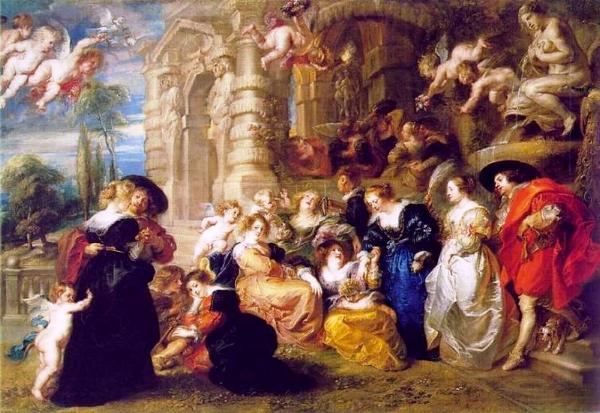
this arc represented in Table "The Garden of Love" , painted years later (in 1630), on which once again, although the picture is not seen the inscription:


I have no documented in what language the inscription was written, whether in Latin or flamenco. It was probably written in the original latino, pues dicha inscripción no es otra cosa que reproducción libre de unos versos latinos de Juvenal, de la Sátira 10 (precisamente la sátira de la que también procede la “sentencia” mens sana in corpore sano ) (Juvenal, Sátiras 10.346-50, 356-60):

permittes ipsis expendere numinibus quid
conveniat nobis rebusque sit utile nostris;
nam pro iucundis aptissima quaeque dabunt di.
carior est illis homo quam sibi. [...]
orandum est ut sit mens sana in corpore sano.
fortem posce animum mortis terrore carentem,
qui spatium vitae extremum inter munera ponat
naturae, qui ferre queat quoscumque work,
nesciat irasci, cupiat nihil. You

delegate to the gods themselves do
for us and what is suitable to our circumstances;
for the gods will grant us, instead of the most joyful, the most appropriate.
Man is dearer to them than for himself.
We ask to have a sane mind in a healthy body. Calls
a strong spirit, oblivious to the fear of death, age
consider a gift of nature,
that can withstand any tests,
unable to fly into a rage, and do not want anything.
Rubens In 1630, widower of his first wife, decided to remarry. The chosen Hélène Fourment was sixteen-year-old daughter of a wealthy merchant. Hélène Rubens served as a model for many paintings, including some of mythological themes, those concerned by Philip IV to decorate the Torre de la Parada: The Three Graces (1625-1930), The Judgement of Paris (1639) and Andromeda released by Perseus (1639-40). All three are in the Museo del Prado .

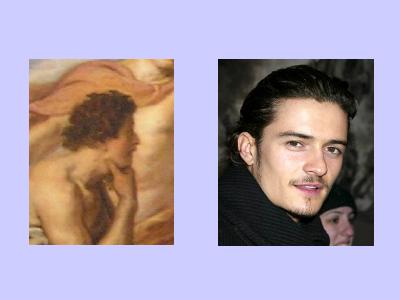
Table The Judgement of Paris is my favorite painter. Paris was the son of the king of Troy, Priam. But it was abandoned by his father in the bush, because the mother, Hecuba, dreamed when I was pregnant with Paris, which gave birth to a burning torch catch fire and destroy the city of Troy. Therefore, Paris grew from childhood among pastors, and pastor appears in the box marked Rubens. By the way, is to note the resemblance of this Paris of Rubens to the actor who plays in the film Paris Troy (2004) , Orlando Bloom . I am convinced that the director, producer or casting makers of the film reminded Paris of Rubens, to characterize the Paris of the film and give the paper:

The god Mercury gives the golden apple Goddess Discordia, commissioned by Jupiter Paris to decide which of three goddesses is more beautiful: Minerva, Venus and Juno. Venus, which occupies the central and prominent position, is a portrait of Hélène Fourment:

This marriage to the young Hélène will stimulate the mature painter, instilling positive spirit and zest for life. The Latin poet Juvenal had deterred in Satire 6 of marriage. But he said that in the rare case that he could find a good wife should make offerings to the goddess Juno in gratitude (Juvenal, Satires 6.47-48). That is exactly what Rubens did when he painted "The Garden of Love. " In this picture is reflected allegorically marital bliss in the garden of his mansion. The putti or cherubs symbolize love. And the source of the right is precisely to Juno, the goddess of marriage, the pipes that flow of love, fertility and happiness.