On December 11 we make a cultural visit to the Museo del Prado , with students of Classical Mythology course (provided by me for the Bachelor of Art History at the University of Córdoba). Our purpose was to discuss a selection of pictures of mythological themes. The visit was interesting and entertaining, I think, but tired (we did the trip back and forth on the day.) There were two problems: bureaucratic rigidity of the rules of the museum, because although we had a group entry previously agreed, with this we were not allowed access to the temporary exhibition "Velázquez's Fables" (especially interested us because included several pictures of mythological), so we had to leave the museum, get a second entry (individual) and re-enter, the second difficulty is that some of the pictures we planned to see, especially followers of Rubens (Cornelis de Vos , Jacob Jordaens), were not exposed in the permanent exhibition but stored in the warehouse. However, the visit was worthwhile.
Enough of the pictures that we were interested Peter Paul Rubens (1570-1640) or his workshop. The Prado has many paintings of Rubens' mythological theme for one simple reason. The Flemish painter in the last decade of his life when he was a respected and sought-after artist, coveted by all courts and aristocratic houses of Europe, received a major order of the English King Philip IV: decorate the walls of the Torre de la Parada (a mansion of rest, located in Monte de El Pardo, the king used for hunting) with about 120 boxes of mythological and hunting themes. Most of the mythological-themed paintings are inspired by episodes narrated by Ovid in his Metamorphoses . Do not forget that Metamorphosis of Ovid were the basic handbook of mythology for European artists, especially since the Renaissance. Well, after many ups and downs (as most of the paintings from the Torre de la Parada were lost in 1710 due to the looting of the stand by the troops of the Archduke Charles during the War of Succession), about fourteen boxes Rubens's mythological, from the series, on display at the Museo del Prado.
Rubens had received a liberal education, classical quite complete. When analyzed with students their mythological works, I like to have an impact on some details that reveal and suggest that knowledge, rather than superficial, of the classic texts. For example, Rubens tried at least two pictures the episode of Achilles' stay on the island of Skyros: "Achilles discovered by Ulysses (in collaboration with Van Dyck) and" Achilles discovered among the daughters of Licomedes "at we will refer immediately.
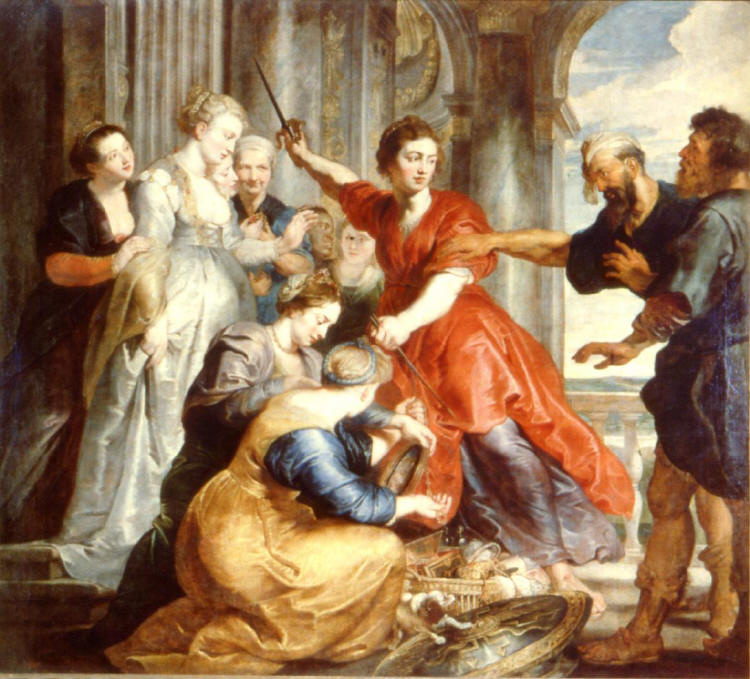
The story is known. The sea goddess Thetis, Achilles' mother, wanted to deliver his son to participate in the Trojan War (the first known case in the history of "conscientious objection"). For this, the disguised girl, when the child was 9, and hid (girl-like) on the island of Skyros, where there was Licomedes between Deidamia (daughter of the King) and her ladies. But the Greeks needed the participation of Achilles, as the seer Calchas had prophesied that Troy could not be conquered if Achilles was not part of the Greek contingent. So Odysseus and Diomedes, disguised as merchants, go to the island, offering clothing and trinkets, mixed with weapons Deidamia and their ladies. Then she reveals the masculine identity of Achilles, for while all the girls are interested in the ornaments, Achilles eyes will go towards weapons. This tells. Well, This episode is captured beautifully in the following table by Rubens, "Achilles discovered among the daughters of Licomedes"

The two characters who whisper to the right are Ulysses and Diomedes. Deidamia is on the left, dressed in white and surrounded by her sisters and ladies. And Achilles occupies the central position, dressed as a girl, but interested in the weapons (it is fitting a helmet on his head.) At this point, I asked the students an apparent banality: what color is the hair of Achilles and why it represents and Rubens?
The answer is: Achilles is depicted as red (interestingly, her dress also matches the color of your hair) and because it represents Rubens knew mythographic detail that when the hero remained in Skyros, disguised as a girl, took the name Pyrrha female (which means, in Greek, "the blonde" or "the redhead"). In fact, the son who would eventually have to Deidamia, which had made her pregnant when he left for the war, also called Pyrrhus (or Neoptolemus), but that's another story.
The episode of the table has, for example, in Ovid, Metamorphoses 13162-170, but that does not mention the name of Pyrrha detail. Sí lo comenta expresamente Higino, en Fábulas 96, pasaje que muy bien pudo ser la fuente mitográfica concreta de Rubens para esto. He aquí el texto latino, y un traducción:
ACHILLES
Thetis Nereis cum sciret Achillem filium suum, quem ex Peleo habebat, si ad Troiam expugnandam isset, periturum, commendavit eum in insulam Scyron ad Lycomedem regem, quem ille inter virgines filias habitu femineo servabat nomine mutato; nam virgines Pyrrham nominarunt, quoniam capillis flavis fuit et Graece rufum "pyrrhon" dicitur. Achivi autem cum rescissent ibi eum occultari, ad regem Lycomeden oratores miserunt, qui rogarent, ut eum adiutorium Danais mitteret. Rex cum negaret apud se esse, potestatem eis fecit, ut in regia quaererent. Qui cum intellegere non possent, quis esset eorum, Ulixes in regio vestibulo munera feminea posuit, in quibus clipeum et hastam, et subito tubicinem iussit canere armorumque crepitum et clamorem fieri iussit. Achilles hostem arbitrans adesse vestem muliebrem dilaniavit atque clipeum et hastam arripuit. Ex hoc est cognitus suasque operas Argivis promisit et milites Myrmidones.
AQUILESLa nereida Tetis, como supiera que su hijo Aquiles, el que tenía con Peleo, moriría si iba a luchar contra Troya, lo confió al rey Licomedes en la isla de Esciros. Éste lo alojaba entre sus hijas doncellas, cambiándole el nombre; pues las chicas lo llamaron "Pyrrha," it was fair-haired and in Greek "red" is said pyrrhon . For its part, the Achaeans, after learning that was hidden there, sent legates to the king Licomedes, asking him to hand him over to help the Achaeans. He said although he was not at home, were granted permission to record the palace. Unable to find them who was the girls Achilles, Odysseus put women's dresses in the area of \u200b\u200bthe hall, mingling among them a shield and spear, and suddenly ordered to sound the bugle and the formation of arms and crying noisily. Achilles, believing that the enemy attacked, tore her dress as a woman and grabbed the coat and lance. For this he was recognized and promised their own work to the Argives and their soldiers, the Myrmidons.
In the next post , second and last of the series, I will discuss another aspect of the knowledge of the classics of Rubens, as an example of practical application to everyday life Classical Tradition. Until then, Merry Christmas.