Now it seems that the Catholic Church has abolished the doctrine of limbo, I do not know if he's also into question the belief in hell as a place where the souls of sinners go after death to suffer everlasting punishment. I am convinced that the Catholic Church assimilated, largely his conception of Hell classical pagan beliefs, and not (or not so) of the Scriptures. Of course, adapting to his purpose. But I will not dwell on this today.
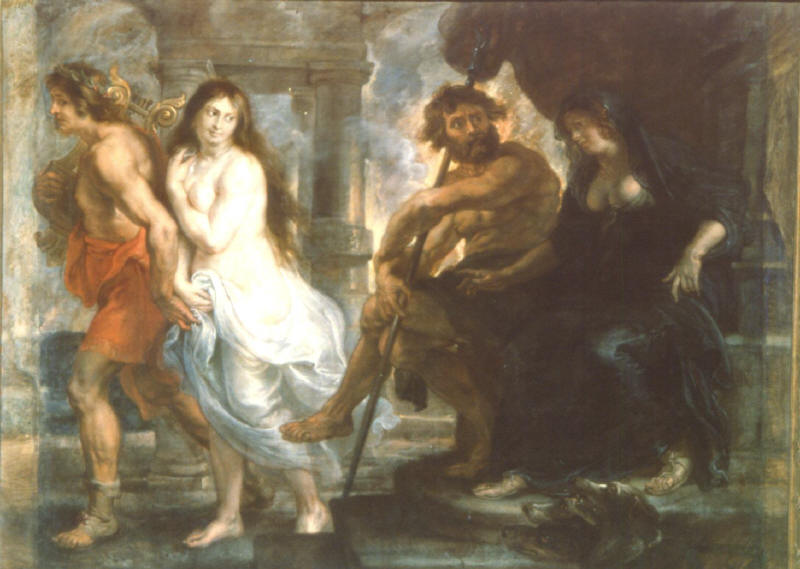
The Greeks and Romans had no unique and unambiguous conception of the afterlife, to which was the fate that awaited the souls of men, when they died. The most widespread belief is that the souls of the dead went to a site located in the basement, called Hades (or Hades). There the spirits are a kind of "life" (if you can call it what, in fact, is non-life) rather bland and faded. Yes, "faded" in a double sense: because his mood is sad, depressed and hopeless, and because the physical and visual appearance of these ghosts is translucent and dark. That is, the Greeks and Romans thought the same as Joaquín Sabina "There is life beyond, but not life."
A peculiarity of Hades is that it is very easy to access this site, but it is very difficult, or impossible, to return there, once you have downloaded. This detail became a literary motif. Here are some examples.
When Catullus mourns the death of Lesbia's bird (in his poem 3), complaining that the animal up now for a road from which no return (vv. 11-18):
In the famous soliloquy "To be or not to be" (of which I spoke here ) of Hamlet in Shakespeare's eponymous tragedy, the protagonist confesses that she committed suicide to avoid having to continue supporting the evils of life, were it not fear the past, which he defines as an "undiscovered country from whose bourn no traveler returns "
The Greeks and Romans had no unique and unambiguous conception of the afterlife, to which was the fate that awaited the souls of men, when they died. The most widespread belief is that the souls of the dead went to a site located in the basement, called Hades (or Hades). There the spirits are a kind of "life" (if you can call it what, in fact, is non-life) rather bland and faded. Yes, "faded" in a double sense: because his mood is sad, depressed and hopeless, and because the physical and visual appearance of these ghosts is translucent and dark. That is, the Greeks and Romans thought the same as Joaquín Sabina "There is life beyond, but not life."
A peculiarity of Hades is that it is very easy to access this site, but it is very difficult, or impossible, to return there, once you have downloaded. This detail became a literary motif. Here are some examples.
When Catullus mourns the death of Lesbia's bird (in his poem 3), complaining that the animal up now for a road from which no return (vv. 11-18):
qui nunc it per iter tenebricosumAs is known, in Book VI of Virgil's Aeneid, Aeneas asks the Sibyl of Cumae instructions to descend to Hades, with the intention de recabar información de los muertos, y regresar después al mundo de arriba, el de los vivos. La sibila le advierte que el descenso es fácil, porque el Averno, como si se tratara de una tienda "after-hours", está abierto las 24 horas del día. Lo que resulta realmente complicado es regresar (vv. 124-129):
illuc, unde redire quemquam disclaimer.
at vobis male sit, malae tenebrae
Orci, quae omnia bella devoratis: tam bellum
abstulistis passerem mihi.
or factum male, or miselle passer,
tua nunc opera meae puellae
flender turgiduli rubent ocelli.
This is now moving that way
dark where they say no one returns.
damn you, damn
darkness of Hades, which engullís all things beautiful!
I have robbed a bird so beautiful!
What Unfortunately, what penalty bird!
Because of you now my girl
loops of red and swollen from time to mourn.
Talibus orabat dictis arasque tenebat,
cum sic orsa loqui vates: «sate sanguine divum,
Tros Anchisiade, facilis descensus Averno:
noctes atque dies patet atri ianua Ditis;
sed revocare gradum superasque evadere ad auras,
hoc opus, hic labor est.
Con tales palabras [Eneas] le imploraba y tocaba los altares,
cuando la sibila took the floor and "blood lineage of the gods, Trojan son of Anchises
is easy descent to Avernus:
the nights and days the door is open Dite;
but make your way back and escape the air above,
that hard, that leads to suffering. "
In the famous soliloquy "To be or not to be" (of which I spoke here ) of Hamlet in Shakespeare's eponymous tragedy, the protagonist confesses that she committed suicide to avoid having to continue supporting the evils of life, were it not fear the past, which he defines as an "undiscovered country from whose bourn no traveler returns "
For Who Would Bear the Whips and Scorned of time, [...] When I Himself MightThe contemporary poet Luis Alberto de Cuenca, from whom I have already quoted several texts on this blog (see here , here and here), because it assimilates and develops nicely several classic songs, is the same reason in a sense poem published originally in the book Verses (1995), and the singer of rock music has Loquillo:
historical
Quietus make With a bare Bodkin? Who Would These Fardles Beare
To grunt and sweat vnder a weary life, But That
Something after the dread of death,
The vndiscouered Countrey, from Whose Borne
Traueller not returned, Puzels the will, And Makes
Rather vs. Beare Those illes we haue, Then flye to
Others Not That we know of.
(vv. 70, 75-82)
For who would bear the whips and downs of the time, [...]
when he himself could obtain peace
with a simple dagger? Who would endure suffering these defects,
to groan and sweat under the burden of life,
if not for the fear of something after death,
to that unknown country from whose edge
no traveler returns, confused
will and makes us bear those ills we have,
before escaping towards others ignored?
WHEN I THINK ABOUT THE FRIENDSFor the image, possibly of Cuenca was inspired by the poem of Catullus 3, which he had translated well in the relevant verses: "Now march by a sinister path / to the country where no one returns. " It is curious that in Catullus not read any equivalent to the word "country", but Luis Alberto de Cuenca enter the word "country" both in his translation of Catullus as in free imitation of the subject in an original poem. No one should be very prudent to suspect that this term took Luis Alberto de Cuenca (perhaps unconsciously) Hamlet's parliament, where, in the context of the same reason, we use the noun "country." And, sometimes, the lines of influence of the classical tradition are complex and sinuous.
When I think of old friends who have gone
of my life,
women agreeing with terrible fear and feeding their children the cover of
to have them around, controlled and powerless.
When I think of old friends were
the country of death, no return trip,
only because they sought pleasure in the bodies
and oblivion in drugs that relieve the sadness.
When I think of old friends who, deep sea
memory, I was offered
one day the strange sensation of not feeling alone
and the complicity of a frank smile ...


